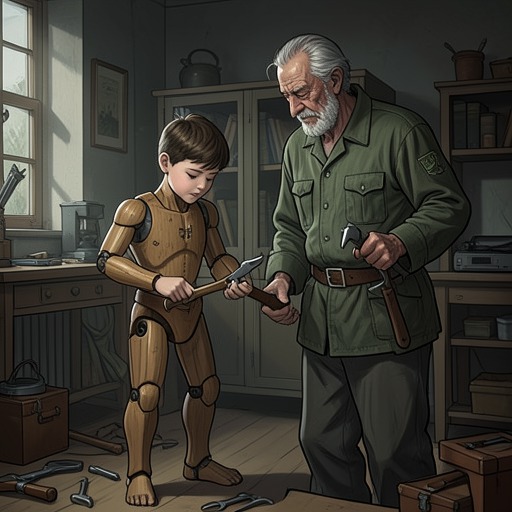
“When bad boys become good and kind, they have the power of making their homes gay and new with happiness.”
The Adventures of PinocchioGeppetto’s declaration, “When bad boys become good and kind, they have the power of making their homes gay and new with happiness,” gives the story’s final transformation a domestic and relational meaning. Pinocchio’s change is not only a reward bestowed on him: his conduct brings happiness and renewal into the home he shares with his father.
The Saying and Its Speaker
The saying occurs when Pinocchio asks Geppetto about the sudden change in their house. Geppetto answers by connecting that change to Pinocchio’s becoming good and kind. The line thus turns an abstract moral lesson into an explanation of what the father and son can see around them: their home is no longer as it was, and Pinocchio’s actions have helped make it new.
Its wording is emphatic but not limited to obedience. The paired qualities “good and kind” make kindness central to the change, while “gay and new” describes happiness as something that can alter the atmosphere of a home. Geppetto speaks as the person who shares in that change, giving the maxim the weight of a father’s recognition rather than leaving it as a detached rule.
The Actions Behind the Maxim
The saying closes a longer movement from resisting advice to accepting responsibility. Early in his journey, Pinocchio dismisses the Talking Cricket’s warnings and reasons that adults invent threats to frighten children who run away. Later, after finding his schoolmate Eugene pale and motionless, he sobs over his own choices, regrets listening to bad company, and recognizes that he has repeatedly done as he pleased despite being warned. The contrast makes the final praise of goodness and kindness a response to a history of disobedience, not a description of how Pinocchio has always behaved.
The decisive change is shown through care for Geppetto. After reuniting with his father, Pinocchio embraces him in joy and says that he will never leave him again. By the final night, he stays up until midnight and makes sixteen baskets instead of the eight he usually makes, then dreams of The Fairy with Azure Hair forgiving him for his old mischief because he loves and cares for his parents when they are old and sick. His labor and care give the maxim its narrative foundation: the household’s happiness follows sustained responsibility, not a sudden declaration alone.
Dream, Recognition, and Renewal
The maxim is paired with the dream in which The Fairy with Azure Hair praises Pinocchio’s care for his parents. When he wakes, he discovers that he is no longer a Marionette but a real live boy, and that the straw-walled room has become a beautifully furnished little room with a new suit, hat, and shoes. The transformation makes the story’s moral outcome visible in both Pinocchio’s body and his surroundings.
Geppetto’s answer then interprets that changed home as the consequence of Pinocchio’s changed conduct. He points to the old wooden puppet leaning against a chair, its head turned aside and its limbs hanging limp or twisted. The abandoned puppet preserves a physical contrast with the lively boy: the household’s renewal and Pinocchio’s new identity are presented together, as parts of the same ending.
Narrative and Ethical Role
The saying gathers the story’s repeated warnings about bad choices into a final affirmation of care. Earlier, Pinocchio’s dismissals of advice are followed by danger and regret; at the close, the emphasis shifts from punishment to what kindness can make possible for other people as well as for the child who changes. The result is a moral statement embedded in a family reunion and a visible change of home, rather than a lesson standing apart from the plot.
The book also addresses its young readers directly: its narrator rejects the expected opening of a story about a king and begins instead with an ordinary piece of firewood. That playful address places the final maxim within a narrative that entertains while inviting children to judge Pinocchio’s choices. Geppetto’s words offer a conclusion, but the story has first made that conclusion legible through Pinocchio’s regrets, his work, his care for his father, and the home they now share.